Pricing
On request
Inquire


Explore deals, travel guides and things to do in Spiti Valley
Spiti is the high, dry, Buddhist half of Himachal Pradesh that most people never quite get to. It sits at 3,800 to 4,500 metres, between the Tibet border and the snow line, and the air is so thin that the first day you arrive you'll find yourself out of breath climbing six stairs. The light is brighter, the silence is louder, and the monasteries are older than most countries.
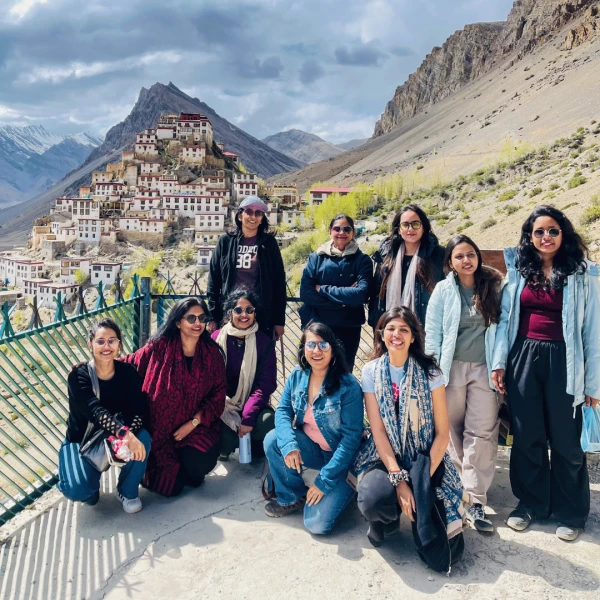
It also happens to be one of the most rewarding places in India for a woman to travel, solo or with a group. The Buddhist culture is gentle, the villages are tiny enough that everyone knows everyone, and the homestays we've built relationships with over the years are run by women who'll feed you butter tea and tell you which monastery to wake up for. We've been running women-only Spiti departures here since 2022 and have hosted around 180 travellers through this valley. Most come solo. Most come back.
There are two ways into Spiti and the road you take determines the season:
If you have to pick one month: June or September. June gives you full road access and wildflowers in Pin Valley. September gives you golden poplar trees, sharper photography light, and fewer travellers on the road. July and August are technically open but carry a higher chance of landslides; we still run trips, but build a buffer day in.
Winter Spiti (December to February) is its own thing: frozen waterfalls, snow leopards on the Kibber plateau, temperatures down to minus 25°C at night. We don't recommend it as a first trip; you want to know the rhythm of the place before you take that on.
Our flagship trip is 8 days, Manali to Manali, with the route going Manali, Chandratal, Kaza, Tabo, Kalpa, Shimla, Chandigarh. We deliberately don't reverse-loop. The slow descent on the Kinnaur side helps your body de-acclimatise, and the contrast between high-desert Tabo and lush green Kalpa in 24 hours is something you'll remember.
Day 2 is the hardest physically: Manali to Chandratal Lake, around 8 hours of driving plus an altitude jump of 1,800 m. We camp at the lake (or at one of the eco-camps just below it, depending on wind), and most of the group is asleep by 9 PM with mild headaches. By Day 4 in Kaza, the headaches are gone and you're attempting Komic's 14-step climb without complaining.
The single moment most travellers talk about months later is sunrise at Key Monastery. We leave Kaza at 5:30 AM, drive 15 minutes up the switchbacks, and stand on the rooftop while monks chant morning prayers and the valley fills with sun. That one's not on the itinerary; it's on every itinerary.
The honest answer is: easier than most of north India. The villages are small Buddhist communities where you'll often see grandmothers running the homestay, women running the shops, and the gender ratio in the local economy feeling far less skewed than it does in, say, Delhi or Manali. We've never had a safety incident in three years of running departures here.
That said, Spiti has its own hazards and they're worth knowing about:
From Manali back to Manali (or Chandigarh, depending on itinerary):
Flights/trains to Manali or Chandigarh, visa fees, and personal expenses are not included.
Our Spiti departures start at ₹25,000 per person twin-sharing. Single supplement is ₹6,000. On top of that, plan for:
All-in, most travellers spend between ₹35,000 and ₹45,000 for the eight days.
The thing nobody tells you about Spiti is how quiet it makes you. Most travellers arrive expecting a high-energy adventure trip and leave realising they've barely used their phones for a week. The valley has a way of slowing you down. By Day 5 the group's WhatsApp chatter dies out, and we usually end up sitting on the Kaza monastery wall at sunset not talking, which sounds dramatic but is actually the point. People come for the monasteries and the photos; they go home with quieter heads.
Use this to orient yourself. Your tour itinerary covers the area shown.
1 curated departure. Swipe to browse.
← Swipe to see more trips →