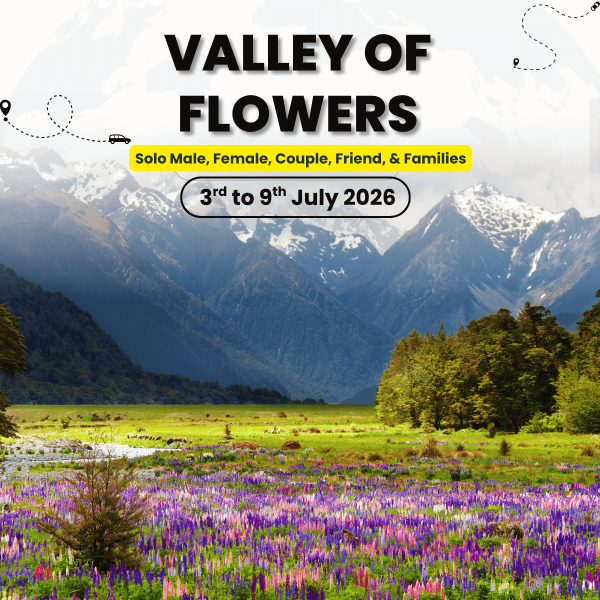
Why women travel to Uttarakhand with Wovoyage
Uttarakhand is the Indian state most women travelers know best from their parents' Char Dham yatra stories and don't realize is also one of the most spectacular trekking destinations in the country. The state holds two distinct travel identities: the spiritual circuit (Rishikesh, Haridwar, Char Dham, Hemkund Sahib) and the high-Himalayan trekking circuit (Valley of Flowers, Roopkund, Nanda Devi Sanctuary, Auli, Munsiyari). Our flagship Uttarakhand trip combines both: the Valley of Flowers trek with Hemkund Sahib pilgrimage and Rishikesh as the start point.
We run a 7-day Valley of Flowers trek in early July: Rishikesh, Govindghat, Ghangaria, Hemkund Sahib and the Valley of Flowers themselves. It's a moderate trek (no technical climbing), open to women travelers from late teens to mid-50s with reasonable fitness, and one of the most flower-photographically rewarding trips in the entire Indian Himalayan circuit. Most bookings are women solo or in pairs of friends.
When to plan your Uttarakhand trip
The Valley of Flowers has a specific, narrow window:
- July to early September (flower season) is the only realistic window for the Valley of Flowers. The valley is officially open from June 1 to October 4, but the flowers peak from mid-July to mid-August. Our scheduled July departure lands at the start of peak bloom.
- August has the absolute peak density of wildflowers (over 500 species), but also the most rain. Trails get muddy and slippery.
- Early September has fewer flowers but clearer mountain views and less rain. Hemkund Sahib lake is at its glacial-blue best.
- October to early November for Char Dham yatra (different itinerary entirely): Kedarnath, Badrinath, Yamunotri, Gangotri. The road remains open into November, then closes for winter.
- April to June for the high-altitude treks beyond the flower valley (Roopkund, Hampta Pass, Brahmatal). Spring fresh, snow patches in shaded areas, no monsoon yet.
- December to March for Auli skiing and Munsiyari snow treks. The Valley of Flowers route is closed; many roads in the upper Garhwal are blocked.
If you're choosing one trip, the July Valley of Flowers departure is the most photographically rewarding and culturally meaningful (Hemkund Sahib is one of Sikhism's holiest gurdwaras at 4,329 m).
A typical Wovoyage Valley of Flowers week
The 7-day route is Rishikesh (1 night), drive to Govindghat (1 night), trek to Ghangaria (1 night, base camp for both the Valley and Hemkund), trek to Valley of Flowers (return to Ghangaria), trek to Hemkund Sahib (return to Ghangaria), trek back to Govindghat, drive back to Rishikesh.
Day 1 is Rishikesh arrival. Triveni Ghat for the Ganga Aarti at sunset (genuinely moving even for non-religious travelers), Beatles Ashram visit, dinner at a riverside vegetarian restaurant. Yoga class in the morning of Day 2 if you opt in.
Day 2 is the long drive to Govindghat (about 10 hours via Devprayag, Rudraprayag, Karnaprayag, Joshimath). The drive itself is part of the trip: you pass the five Prayags (sacred river confluences), the Char Dham yatra route, and steadily climb from Rishikesh's 372 m to Govindghat's 1,828 m.
Day 3 is the trek from Govindghat to Ghangaria. 13 km, about 6 to 8 hours depending on pace. The trail follows the Lakshman Ganga river, gradually climbing through pine forests, passing pilgrim halt-points where you can buy tea and snacks. Ghangaria is a small Sikh pilgrim village at 3,049 m. Stay at a basic but clean hotel or gurdwara dormitory.
Day 4 is the Valley of Flowers day. 4 km from Ghangaria to the valley entrance, then up to 4 km into the valley itself (depending on your fitness and the day's conditions). The valley is a U-shaped glacial cirque between 3,200 and 3,700 m, packed with wildflowers including the Brahma Kamal (Saussurea obvallata), the state flower. Photography is best in mid-morning and after a brief rain when the colors saturate. Return to Ghangaria for the night.
Day 5 is the Hemkund Sahib day. 6 km uphill from Ghangaria to the gurdwara at 4,329 m. This is the highest gurdwara in the world, surrounded by seven peaks, with a glacial lake. The climb is steep but well-paved; expect 4 to 6 hours up and 3 hours down. Most travelers find this physically harder than the Valley of Flowers day. Return to Ghangaria.
Day 6 is the trek back to Govindghat (mostly downhill, 4 to 5 hours), then drive partway back to Joshimath or Pipalkoti for the overnight.
Day 7 is the final drive back to Rishikesh and departure or onward connection.
What it's actually like as a woman traveler here
The Valley of Flowers route is one of the safest Indian Himalayan treks for solo female travelers. The pilgrim traffic on the route (mostly Sikh families going to Hemkund) means you're rarely alone on the trail. The Ghangaria village is small enough that everyone knows everyone. Friction points are physical, not safety:
- Altitude (AMS). The trek climbs from 1,828 m to 4,329 m over 4 days. Most travelers feel mild symptoms on Day 4 or 5. We acclimatise gradually (full Day 1 in Govindghat at 1,828 m, slow climbs after), carry diamox, and our trip leaders are trained to spot symptoms. If you have a known AMS issue, tell us at booking.
- Rain and trail conditions. July to August is the wettest part of the year. Trails get muddy and slippery. Bring waterproof trekking shoes (not running shoes), a rain jacket, a backpack rain cover, and at least two pairs of dry socks per day. We brief on packing two weeks before departure.
- Period products. Bring everything you need from Rishikesh. Govindghat has a basic pharmacy; Ghangaria has nothing.
- Vegetarian and Jain food. The entire route is pure vegetarian (Sikh and Hindu pilgrim culture). Jain travelers should specify at booking; we coordinate with the Ghangaria accommodations.
- Sun and cold. UV at altitude is intense even when cloudy. SPF 50, lip balm with SPF, sunglasses. Ghangaria nights are 6 to 10°C in July; bring a warm fleece.
- Mobile signal. BSNL works at Govindghat. Above Govindghat (Ghangaria, Valley, Hemkund), signal is patchy to none. Tell people at home you'll be largely offline for 3 days.
- Cash. Govindghat is the last reliable ATM. Bring ₹8,000 to ₹10,000 in cash for the high-altitude portion (porter tips, gurdwara donations, snack stalls).
What's included in a Wovoyage Uttarakhand trek
For the 7-day Valley of Flowers and Hemkund Sahib trek:
- Accommodation: a Rishikesh riverside hotel, hotels in Govindghat and Pipalkoti, and basic hotel-style accommodation in Ghangaria (this is a pilgrim village; luxury isn't available). Twin-sharing default.
- Ground transport: Rishikesh-Govindghat and back in a Tempo Traveller with an experienced mountain driver.
- Trekking permits and forest department fees for the Valley of Flowers National Park.
- All breakfasts and dinners; lunches at trail dhabas and en route (₹150 to ₹250 per meal).
- A female Wovoyage trip leader experienced in this specific route, plus a local trek guide for the Valley and Hemkund sections.
- Medical kit including diamox, oxygen canister, pulse oximeter.
- Backpack porter (optional, ₹500 per day extra; many travelers carry their own).
Trekking gear (shoes, jackets, sticks), train or flight to Haridwar/Dehradun, and personal expenses aren't included.
Real cost picture
Our scheduled Valley of Flowers trek is ₹19,999 (early-bird) to ₹21,999 per person twin-sharing for the 7-day trip. Single supplement is ₹4,500.
On top:
- Train or flight to Haridwar / Dehradun: ₹2,500 to ₹6,000 round trip from any Indian metro.
- Lunches over 6 days: ₹1,500 to ₹2,500.
- Trekking shoes if you don't own a proper pair: ₹3,000 to ₹6,000 (Decathlon Quechua or similar).
- Rain jacket if you don't own one: ₹1,500 to ₹4,000.
- Optional add-ons: porter for backpack (₹500/day), pony ride to Hemkund (₹1,500 one way, useful for travelers with knee issues), Rishikesh river rafting on the Day 1 or post-trek day (₹1,500 per person).
- Tips for trip leader, driver, and porters: ₹1,500 to ₹2,500 total.
All-in, most travelers spend between ₹28,000 and ₹35,000 for the week including travel to and from Uttarakhand.
What surprised our last group
People come for the Valley of Flowers (the famous one). They go home talking about Hemkund Sahib. The combination of the 4,329-metre altitude, the glacial lake, the silver gurdwara reflecting in the water, and the freshly-cooked langar (community meal) served to every visitor regardless of religion, is the part most travelers describe as the trip's emotional peak. The flowers are the photo. Hemkund is the moment. Our last July group spent 90 minutes at the gurdwara that we had only budgeted 45 minutes for, and nobody complained.